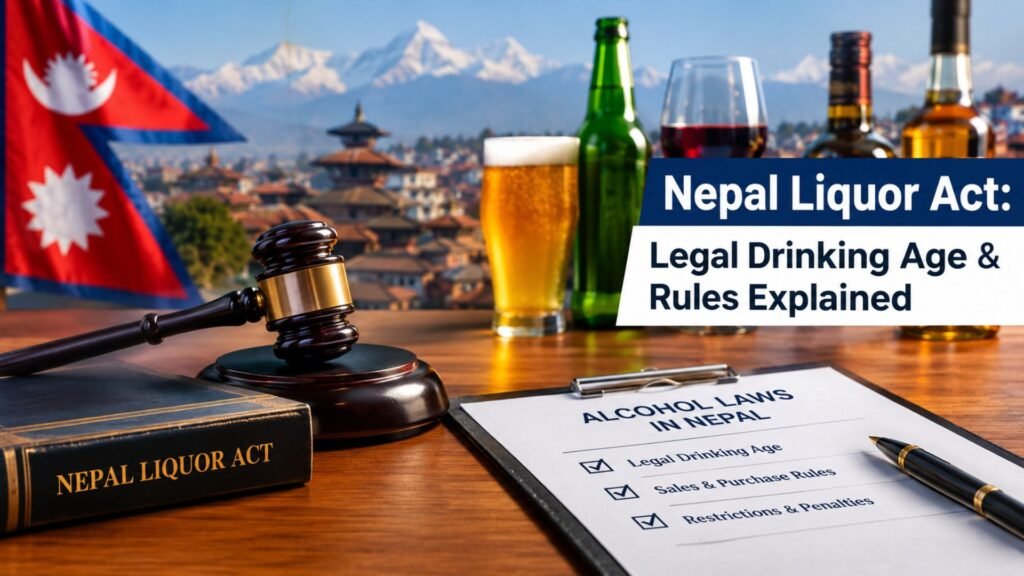
Nepal’s legal drinking and purchase age is 18, set by Section 4A of the Liquor Act, 2031 (1974). No one under 18 can buy alcohol, sell it, or hold a liquor license. Sales generally run 10 AM to 10 PM, pause on designated dry days, and stay restricted near schools and religious sites, with violations risking fines up to NPR 100,000 or jail time.
Ask five people in Kathmandu what the legal drinking age in Nepal actually is, and you might get five different answers. Some will say 18.
A few will insist it’s 21, confusing it with the age limit in other countries or with an outdated rule they half-remember. While researching this article, we even found an active law-firm blog online stating the age is 21, which just isn’t accurate.
So let’s clear it up properly. Nepal’s alcohol laws come from one main piece of legislation, and it says exactly what the age limit is, who needs a license to sell liquor, and what happens if you break the rules. Here’s what liquorshopnepal.com customers, and anyone running a liquor business in Nepal, actually needs to know.
What Is the Legal Drinking Age in Nepal?
The legal drinking age in Nepal is 18 years old. That’s not a guideline or an industry norm, it’s written directly into law.
Section 4A(2) of the Liquor Act states that “no person shall sell and distribute liquor to a person who has not completed the age of eighteen years.” Section 4A(3) goes further and says a seller themselves must be at least 18, so a minor can’t legally work behind a liquor counter either. Section 6A adds a third layer: no liquor license will be issued to anyone under 18, full stop.
In other words, the age restriction covers three separate people at once: the buyer, the seller, and the license holder. Miss any one of those, and you’re in violation of the Act, even if the other two checks out.
Here’s the thing though: having the legal right to buy alcohol at 18 doesn’t mean every shop, bar, or hotel will sell to you without checking ID. Reputable retailers, including online ones, still verify age before completing a sale, because the penalty for getting it wrong falls on them, not the customer.
What the Liquor Act 2031 Actually Says
The Liquor Act, 2031 (1974) is the primary law governing alcohol in Nepal, and it’s been in place for five decades now. It’s supplemented by the Liquor Rules, 2033 (1976), which fill in the operational details the Act leaves open, plus excise notifications issued periodically by the Ministry of Finance.
A few provisions matter most for everyday buyers and sellers. The Liquor Act, 2031 (1974) official text lays these out directly. Section 4A(1) bans producing, selling, or distributing liquor in plastic pouches entirely, a rule aimed squarely at cheap, easily-hidden packaging. Section 3 requires a license for production, and Section 4 requires one for selling, distributing, or running any establishment that serves liquor.
Then there’s Section 12(1), the enforcement teeth of the whole Act: anyone who breaks it “shall be punished with imprisonment for a term not exceeding six months or fine of up to one hundred thousand rupees or with both punishments.” That’s a wide range, and courts have discretion within it, but it tells you the government treats liquor violations seriously rather than as a minor paperwork issue.
Now, this doesn’t mean every small infraction lands someone in jail. In practice, first-time issues like a missing sign or an expired renewal usually mean a fine and a warning. Repeat violations, unlicensed operations, or selling to minors are where the harsher end of Section 12 tends to get applied.
Where and When You Can Legally Buy Alcohol?
Retail alcohol sales in Nepal are generally restricted to a window of around 10 AM to 10 PM, though the exact hours can shift slightly depending on the municipality and the type of establishment. A licensed off-trade shop and a hotel bar don’t always run on identical schedules.
On top of the daily window, Nepal observes what are commonly called “dry days,” when alcohol sales are suspended entirely. These typically include election days, national days of mourning, and certain local festival dates set by municipal authorities. If you’ve ever wondered why a shop that’s normally open turns you away on a specific date, this is usually why.
Location matters too. Retail alcohol sales are restricted near schools, hospitals, and religious sites, and additional distance rules apply close to international border areas. The exact distances cited vary depending on the source and the local government’s own bylaws, so if you’re setting up a shop near a sensitive location, it’s worth confirming the current figure with your municipality directly rather than relying on a blog post, including this one.
Buying online doesn’t sidestep any of this. A licensed online liquor store still has to observe the same age, hour, and dry-day rules as a physical shop, and a legitimate seller will build those checks into checkout rather than treat them as optional.
Liquor Licensing Rules If You’re Selling, Not Just Buying
If you’re on the business side of this instead of just shopping, the rules get more involved. Nepal issues liquor licenses through the Department of Revenue Investigation (DRI), under the Ministry of Finance, and there are several categories depending on what you actually do: retail, wholesale and distribution, brewery or distillery production, wine and cider production, import and export, and short-term permits for special events.
Getting a retail license generally means working through the same rough sequence:
- Register the business itself, including a PAN certificate
- Complete tax registration and obtain a tax clearance certificate
- Get a recommendation letter from the local municipality
- Pass a site inspection of the premises
- Secure an Excise Duty Certificate to finalize the license
For a retail operation, the whole process commonly takes two to four months from start to finish, so it’s not something to start planning the week before you want to open. And renewal isn’t automatic either. Applications typically need to go in around 30 days before the current license expires, with updated documentation and, sometimes, a fresh premises inspection.
One nuance worth mentioning: license fees and processing costs aren’t fixed nationally the way the age rule is. They vary by business type, location, and local government, so two shops in different districts can pay noticeably different amounts for what looks like the same category of license. If you’re budgeting for a new liquor business, treat published fee ranges as a starting estimate, not a quote.
Drink-Driving Laws and Other Penalties You Should Know
Nepal’s approach to drink-driving is blunt: zero tolerance. Under the Motor Vehicles and Transport Management Act, 2049, the permissible breath alcohol content for any driver, on a motorcycle, in a private car, or behind the wheel of a commercial vehicle, is 0 mg/L.
There’s no “under the limit” here the way there is in some countries. If you’ve had a drink, you’re not supposed to drive, and refusing a breathalyzer test is treated the same as failing one.
Penalties escalate with each offense. A first-time violation typically brings a fine plus a license suspension, with a higher fine and longer suspension for commercial drivers specifically.
Repeat offenders face steeper fines and can face up to a year in prison alongside license cancellation. If a drink-driving incident causes a death, the charge shifts toward negligent homicide, which carries a multi-year prison sentence and victim compensation on top of it.
Public consumption is its own separate issue from driving. Drinking in roads, parks, public transport, or government buildings is prohibited under the Muluki Criminal Code, and it can bring a fine even when no vehicle is involved at all. A peer-reviewed analysis of Nepal’s alcohol legal framework notes that Nepal also restricts most forms of alcohol advertising outright, which is one reason you won’t see liquor brands running the kind of ad campaigns common in less regulated markets.
None of this is meant as legal advice, and if you’re facing an actual violation or building a business around it, talk to a lawyer or the DRI directly. Laws get amended, local bylaws differ, and the stakes are too high to rely on a single article, this one included.
Shopping and Selling Responsibly
Nepal’s liquor laws aren’t especially complicated once you see them laid out, but they touch more than most people expect: the age of the buyer, the age of the seller, the hours of the sale, the location of the shop, and how you get there afterward. Whether you’re picking up a bottle for the weekend or getting a retail license off the ground, the age-18 rule is the one constant running through almost every section of the Act.
If you’re old enough to buy and you’re looking for something specific, browse our full whisky selection to see what’s in stock, or head to our full online shop if this is your first time ordering online.
FAQ
1. What is the legal drinking age in Nepal? A: The legal drinking age in Nepal is 18, as set out in Section 4A of the Liquor Act, 2031 (1974). This applies to purchasing alcohol, selling it, and holding a liquor license, all three require the person to be at least 18.
2. Can a shop get in trouble for selling alcohol to someone under 18? A: Yes. Selling to a minor violates Section 4A(2) of the Liquor Act, and penalties under Section 12(1) can include a fine of up to NPR 100,000, imprisonment of up to six months, or both, depending on the severity and whether it’s a repeat offense.
3. What is the blood alcohol limit for driving in Nepal? A: Nepal applies a zero-tolerance policy. Under the Motor Vehicles and Transport Management Act, 2049, the permitted breath alcohol content is 0 mg/L for every type of driver, so any detectable alcohol while driving is a violation.
4. Can I buy alcohol online in Nepal? A: Yes, licensed online retailers can sell alcohol in Nepal, but they still have to follow the same age verification, sale-hour, and dry-day restrictions as physical shops. A legitimate seller checks your age before completing the order.
5. What are “dry days” in Nepal? A: Dry days are specific dates when alcohol sales are suspended nationwide or locally, commonly including election days, national days of mourning, and certain festival dates. Retailers, including liquor shops, cannot legally sell alcohol on these dates.
6. How long does it take to get a liquor license in Nepal? A: For a retail license, the process commonly takes two to four months, covering business and tax registration, a municipal recommendation, a site inspection, and the issuance of an Excise Duty Certificate through the Department of Revenue Investigation.